AI in 2026 and the Snowden Warning That Mass Surveillance Has Found Its Final Form
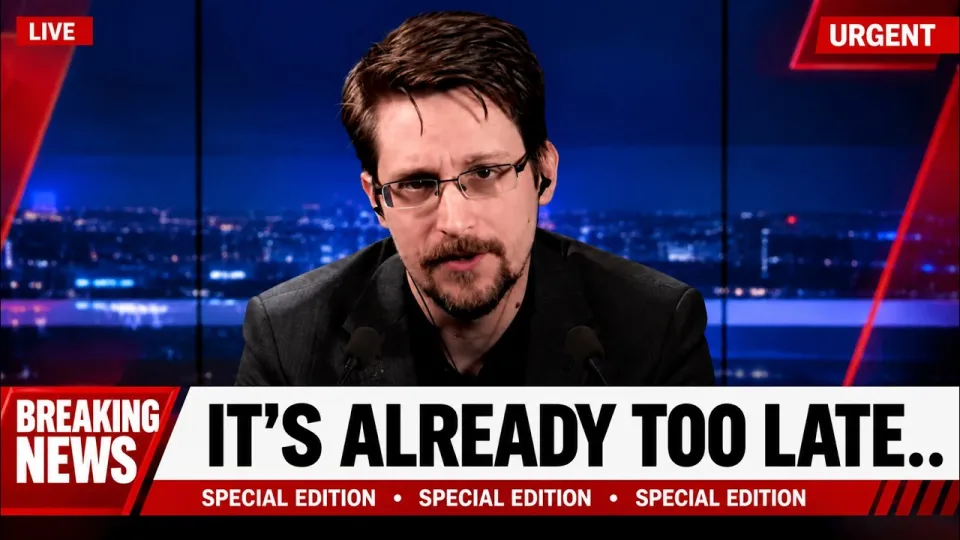
Video: AI Will ENSLAVE US - SNOWDEN Tries to Warn Us (Shocking Interview)
Need articles like this for your video? They help promote it on YouTube and Google — order them in the Telegram bot @sat_sit_bot. The bot writes and publishes the articles itself (with your YouTube video embedded) on popular topical websites (no ads). Try it free: 50 articles on us.
· based on the channel NeuralHegemony
Key takeaways
- Edward Snowden's AI remarks circulated in a video drawn from his live virtual appearance at NEAR Protocol's Redacted 2024 conference, originally published on November 12, 2024.
- Snowden argues that AI turns mass surveillance from stored records into real-time analysis of calls and speech from the first word.
- Palantir-style data fusion is described as flagging 'weird people' by combining records that were previously kept in separate systems.
- Street cameras with speech transcription and always-on phones mean privacy is no longer lost by choice but by default.
- Snowden also warns of a 'tyranny of mediocrity', where recommendation algorithms flatten creativity and independent thinking.
AI in 2026 is best understood as the moment surveillance stopped being about storing records and started being about instant interpretation: Edward Snowden's core warning is that machine learning turns every call, camera feed and data trail into a live, searchable profile, and that the same systems quietly standardise how we think. His remarks, delivered in a live virtual appearance at NEAR Protocol's Redacted 2024 conference and later republished, frame the technology not as a single tool but as the operating layer of a new kind of control. Readers who want to act on the financial side of digital life can start with an Interactive Brokers account application, the brokerage offer attached to the video.
What Snowden actually says about AI and surveillance
Snowden's argument is structural rather than conspiratorial: the danger is not one omniscient machine but the normalisation of total analysis. He describes calls being parsed from the very first word, so that meaning, tone and intent are extracted in real time rather than reconstructed later from a recording. In the 2013 disclosures he showed that governments were collecting metadata at scale; his point now is that content itself is cheap to process, because models can listen to everything at once and summarise it for a human analyst who never has to read the raw material.
A second strand is data fusion. Contractors such as Palantir built their business on joining datasets that were designed to stay separate — phone records, travel logs, financial transactions, social posts — into a single graph. Snowden's phrasing about systems tracking "weird people" captures the logic: the model does not need to know what you did wrong, only that you deviate from a statistical norm. Deviation becomes the flag, and the burden shifts to the individual to explain themselves.
The three layers of the current surveillance stack
- Ambient audio. Phones, smart speakers and street cameras with microphones capture speech continuously; transcription models convert it into text that is searchable and summarisable at negligible cost.
- Identity graphs. Commercial data brokers and fusion platforms merge identifiers across services, so an anonymous account rarely stays anonymous once it touches a payment method, a device ID or a location history.
- Predictive scoring. Models rank people by risk, creditworthiness, dissent or simply unusual behaviour, and those scores feed decisions about loans, travel and policing.
The practical consequence is that privacy is no longer lost through a single dramatic act. It erodes through defaults: the app that asks for microphone access, the camera that logs every passer-by, the terms of service accepted in four seconds. Snowden's earlier revelation was that the state could ask for this data; the current phase is that the infrastructure generates it whether or not anyone asks.
Why the 'tyranny of mediocrity' matters more than cameras
The less-discussed half of Snowden's warning is cultural. Recommendation systems optimise for engagement, and engagement rewards the familiar, the emotionally simple and the mildly provocative. Over time, the feedback loop narrows what creators make and what audiences see, so that originality is penalised by the metrics before any editor or censor has to intervene. Snowden frames this as an invisible force that flattens creativity and independent thought — a tyranny exercised not by a dictator but by an average.
This connects to a classical argument: John Stuart Mill warned in On Liberty that social pressure, not law, is the most effective suppressor of unconventional opinion. Algorithms industrialise that pressure. They do not forbid heterodox ideas; they simply rank them below content that keeps people scrolling. The result is a public sphere that feels free and behaves conformist.
Is privacy already dead, and what can one person still do
Privacy is not dead as a legal principle, but it is largely dead as a default. The realistic goal is not invisibility but reducing the number of high-value data points you emit. Concretely:
- Treat the microphone and location permissions as sensitive; revoke them for apps that do not need them to function.
- Separate identities where it matters: a dedicated email and payment method for accounts you do not want linked to your real name.
- Prefer end-to-end encrypted messaging and check whether a service reads message content for features or advertising.
- Assume any camera in a public space can transcribe speech, and behave accordingly in sensitive conversations.
- Audit the data brokers that hold your records; most offer opt-out requests, which are slow but effective.
None of this defeats a determined state-level adversary. It does raise the cost of casual, automated profiling, which is where most of the current harm occurs.
Questions viewers keep raising about the interview
Several recurring doubts deserve direct answers. First, the material is not new: the footage originates from Snowden's live virtual appearance at NEAR Protocol's Redacted 2024 conference, recorded and published on November 12, 2024, and has been re-edited since. Second, some viewers suspect the voice or the speaker is synthetic; the substance of the arguments matches Snowden's documented positions on encryption and surveillance, but any specific upload should be checked against the original conference recording before being cited.
Third, the strongest objection is that AI is only software and cannot act without human hands. That is technically correct and misses the point: the harm comes from humans using automated systems at a scale where no individual reviews the decision. Fourth, there is a fatalistic view that freedom was always an illusion. The more useful framing is that the degree of exposure is a policy choice — encryption, data protection law and platform design all change what is collected, and all of them have changed before.
Where the video's own link leads
The video's primary promotional link points to the Interactive Brokers universal account application, the online brokerage referenced in the video description. It is a registration and account-opening page for the broker's trading platform, not a privacy tool, and it carries the usual risks of investing and of handing identity documents to a financial institution. Viewers should evaluate it on its own merits rather than as part of the surveillance argument.
Conclusion
Snowden's warning is less about a machine uprising than about an infrastructure that listens, merges and scores by default, while algorithms quietly reward conformity. The surveillance layer and the cultural layer reinforce each other: the same systems that transcribe your speech also decide which ideas reach you. This breakdown was produced by the channel NeuralHegemony, which assembled the interview footage and commentary. The practical response is to treat data emission as a choice, however constrained, and to keep checking claims against primary recordings. For those interested in the sponsor of the original upload, the Interactive Brokers application page remains the starting point.
Questions & answers
Is the Snowden interview in this video new?
No. The footage comes from Edward Snowden's live virtual appearance at NEAR Protocol's Redacted 2024 conference, originally recorded and published on November 12, 2024. Later uploads re-edit and re-narrate that material, so the arguments are his, but the packaging is not new.
Does AI really listen to every phone call?
Not literally every call, and not with a human listening. The realistic model is automated transcription and keyword or intent analysis at scale, with humans reviewing only flagged excerpts. The cost of processing audio has fallen far enough that mass analysis is economically trivial for large platforms and agencies.
What does Snowden mean by the tyranny of mediocrity?
He means that recommendation algorithms optimise for engagement, which rewards familiar and mildly provocative content over original thinking. The result is a gradual narrowing of what gets made and seen, achieved without any censor issuing orders. It echoes John Stuart Mill's warning that social pressure suppresses dissent more effectively than law.
If AI is just software, why is it described as a threat?
Because the harm comes from humans deploying automated decisions at a scale no one reviews. A model that flags unusual behaviour, denies a loan or ranks a person as risky acts without intent, but the consequences are real and hard to appeal. The tool is neutral; the deployment is not.
Source: AI Will ENSLAVE US - SNOWDEN Tries to Warn Us (Shocking Interview) · Markdown version