How to Understand Bill Gates's AI Warning About Catastrophic Risk and Weak Regulation
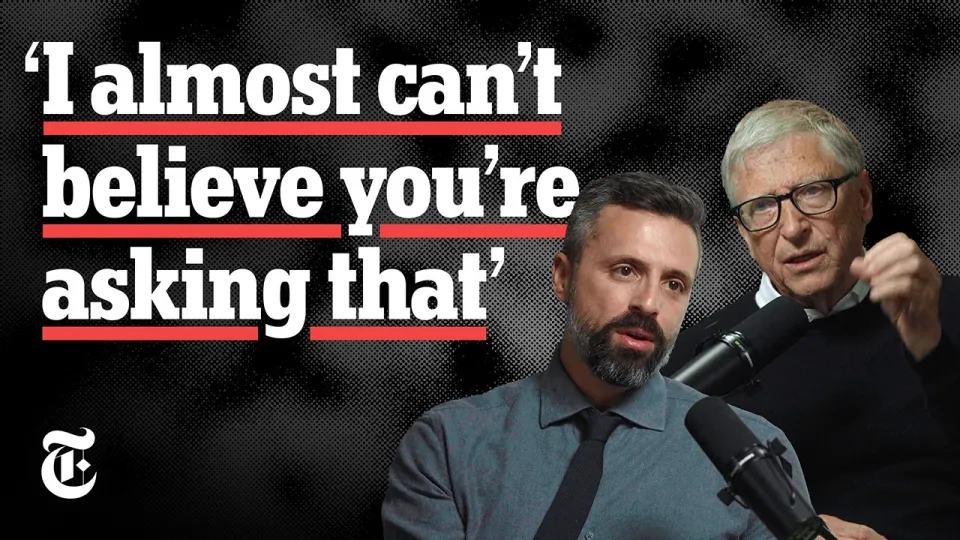
Video: Bill Gates: A.I. ‘Makes Nuclear Weapons Look Like Nothing’ | The Ezra Klein Show
Need articles like this for your video? They help promote it on YouTube and Google — order them in the Telegram bot @sat_sit_bot. The bot writes and publishes the articles itself (with your YouTube video embedded) on popular topical websites (no ads). Try it free: 50 articles on us.
· based on the channel The Ezra Klein Show
Key takeaways
- Gates calls AI the most dangerous technology humans have approached, saying it makes nuclear weapons 'look like nothing.'
- He names two near-term thresholds: catastrophic cyberattacks and bio-terrorism enabled by AI tools.
- Industry self-regulation is 'insane' in Gates's view; he compares relying on lawsuits to a catastrophe killing 100 million people.
- The Gates Foundation plans to spend down roughly $200 billion over two decades and has made AI-driven inequality a new priority.
- Gates pushes back on the idea that capitalism alone will supply safety incentives, a point he debates against Jensen Huang's position.
To understand Bill Gates's AI warning, separate it into four claims: the technology is more dangerous than nuclear weapons, the first real thresholds are cyber and bio, self-regulation by AI companies cannot work, and governments must act before those thresholds are crossed. Gates made the case in a conversation with Ezra Klein, and the full transcript is available through The Ezra Klein Show episode page. His framing is not that alarmism has gone too far, but that it has not gone far enough.
What Gates actually means by comparing AI to nuclear weapons
Gates's comparison is about the speed and accessibility of harm, not about blast radius. Nuclear weapons require fissile material, enrichment plants and state-level infrastructure; a model that can help design a pathogen or write exploit code requires electricity and a laptop. That asymmetry is why he argues AI "makes nuclear weapons look like nothing" as a governance problem: the capability spreads faster than any treaty process can track it.
He also draws a line between two kinds of risk. Near-term risk is concrete and already visible — cyberattacks, fraud, biological misuse. Longer-term risk is the loss of human control over systems that improve themselves. Gates spends most of his time on the first category because it is where policy can still bite, and because he believes the second is being used by some in the industry as a distraction from the first.
The two thresholds Gates says we are approaching
Gates identifies cyber and bio as the thresholds where AI moves from a productivity tool to a weapon-enabler, and he treats both as near-term rather than speculative.
- Cyber. Offensive security work that once required a skilled team — finding vulnerabilities, chaining exploits, automating attacks at scale — becomes cheap and fast. Defenders get the same tools, but Gates's concern is the asymmetry: an attacker needs one success, a defender needs all of them.
- Bio. The harder and more alarming case. Gates has spent two decades funding pandemic preparedness through the Gates Foundation, and he argues that the marginal cost of doing harm in biology is falling faster than the cost of detecting it. He is explicit that a lawsuit is not a serious response to an event that could kill tens of millions.
The practical implication is that safety evaluation cannot be voluntary and cannot be limited to the largest labs. A capability that is dangerous in one model is dangerous in any model that reaches the same benchmark, including open-weight releases.
Why Gates calls AI self-regulation 'insane'
Gates's argument against self-regulation is structural, not personal: the incentives of a competitive market point away from the behavior safety requires. If one lab pauses to run evaluations and a rival ships, the pausing lab loses market position and the risky capability ships anyway. Voluntary commitments therefore hold only until they become expensive.
He is equally dismissive of liability as the main remedy. Suing a company after a catastrophic release is, in his framing, close to meaningless — the harm is irreversible and the entity may not survive to pay. Regulation has to come before deployment, with thresholds, audits and licensing for the most dangerous capability classes, in the way that biological agents and nuclear materials are already controlled.
This is where Gates parts company with the view, associated with Nvidia's Jensen Huang, that market incentives will supply their own safety remedies. Gates's reply is historical: markets did not solve leaded gasoline, ozone-depleting chemicals or tobacco on their own. Each required rules that made the harmful behavior costly.
The China race and why it weakens safety arguments
Gates treats the US–China AI competition as the strongest practical obstacle to regulation, and he does not dismiss it. If one country slows down and another does not, the safety gain is partial while the strategic cost is real. His answer is not to abandon regulation but to aim it at capabilities rather than at companies or countries: rules that apply to anyone who crosses a threshold, plus international agreements on the narrowest and most dangerous categories.
That is a harder political sell than a national pause, which is why Gates keeps returning to the same point — the current default, where nobody agrees on thresholds, is the worst of the available options.
Jobs, inequality and the Gates Foundation's new priority
Gates expects mass job displacement and treats it as a policy question rather than an inevitability. His proposals in the conversation include:
- Taxing AI labor. If machine work replaces human work, the tax base that funds social insurance erodes unless something replaces payroll revenue.
- 'Human reserved' jobs. Sectors where people explicitly want a human on the other end — care, education, some public services — could be protected by rule rather than left to the market.
- A no-scarcity job market. Gates argues that if AI makes goods and services much cheaper, the political question becomes distribution, not total output.
He also flags a specific inequality risk: the productivity gains of AI concentrate in rich countries and in English-language data, while developing nations — where the Gates Foundation spends most of its money — get the disruption without the upside. Making AI a force for equality rather than a driver of inequality is now an explicit foundation priority, alongside a planned spend-down of roughly $200 billion over the next two decades.
Common objections, answered
The strongest pushback to Gates is that his warnings are unfalsifiable and that incumbents benefit from rules that raise costs for newcomers. That objection has force, and the design of regulation matters: licensing regimes written by the largest labs tend to entrench them. Capability thresholds, published evaluations and independent auditors are the version less vulnerable to that critique.
A second objection is that Gates is late to this position, having spent years as an AI optimist focused on health and education gains. He does not dispute the shift; he argues the evidence changed, particularly on bio risk and on the speed at which models crossed benchmarks his earlier estimates had placed years out.
A third is that he is a technologist asking for restraint from a position of already having won. Gates's answer is that the foundation's spending commitments and his focus on developing-world access are the parts of his position that cost him something.
Useful links
- Full transcript of the Bill Gates conversation on The Ezra Klein Show
- Book recommendations from guests of The Ezra Klein Show
What to take away from Gates's AI warning
Gates's position is narrower and more actionable than the headline suggests: he is not asking for a pause on AI, he is asking for rules that apply before deployment, aimed at the cyber and bio capabilities that could cause irreversible harm. The self-regulation argument fails on incentives, and liability fails on timing. The job and inequality questions are the same problem in slower motion — the gains arrive first in rich countries and the disruption arrives everywhere. The conversation is worth reading in full at the transcript link above, and The Ezra Klein Show is the source of the interview this analysis draws on.
Questions & answers
Why does Bill Gates say AI makes nuclear weapons look like nothing?
He is pointing at accessibility rather than destructive power. Nuclear weapons need state-level infrastructure to build, while a model capable of helping design a pathogen or automate attacks needs only a laptop and electricity. That gap between how fast the capability spreads and how slowly rules are written is the core of his warning.
Does Gates want AI development paused?
No. He argues for regulation aimed at specific dangerous capabilities — mainly cyber and bio — with thresholds, audits and licensing before deployment. He rejects both voluntary self-regulation and reliance on lawsuits after a catastrophe, but he does not call for a moratorium on AI research.
What does Gates say about AI and jobs?
He expects significant displacement and treats it as a policy problem. His proposals include taxing AI labor to replace eroding payroll revenue, designating some 'human reserved' roles, and planning for a market where AI-driven abundance makes distribution, not output, the central political question.
How does the Gates Foundation fit into this?
The foundation plans to spend down roughly $200 billion over two decades and has made AI-driven inequality a new priority. Gates argues gains concentrate in rich countries and English-language data, so developing nations risk getting the disruption without the benefits unless access is deliberately built in.
Source: Bill Gates: A.I. ‘Makes Nuclear Weapons Look Like Nothing’ | The Ezra Klein Show · Markdown version